
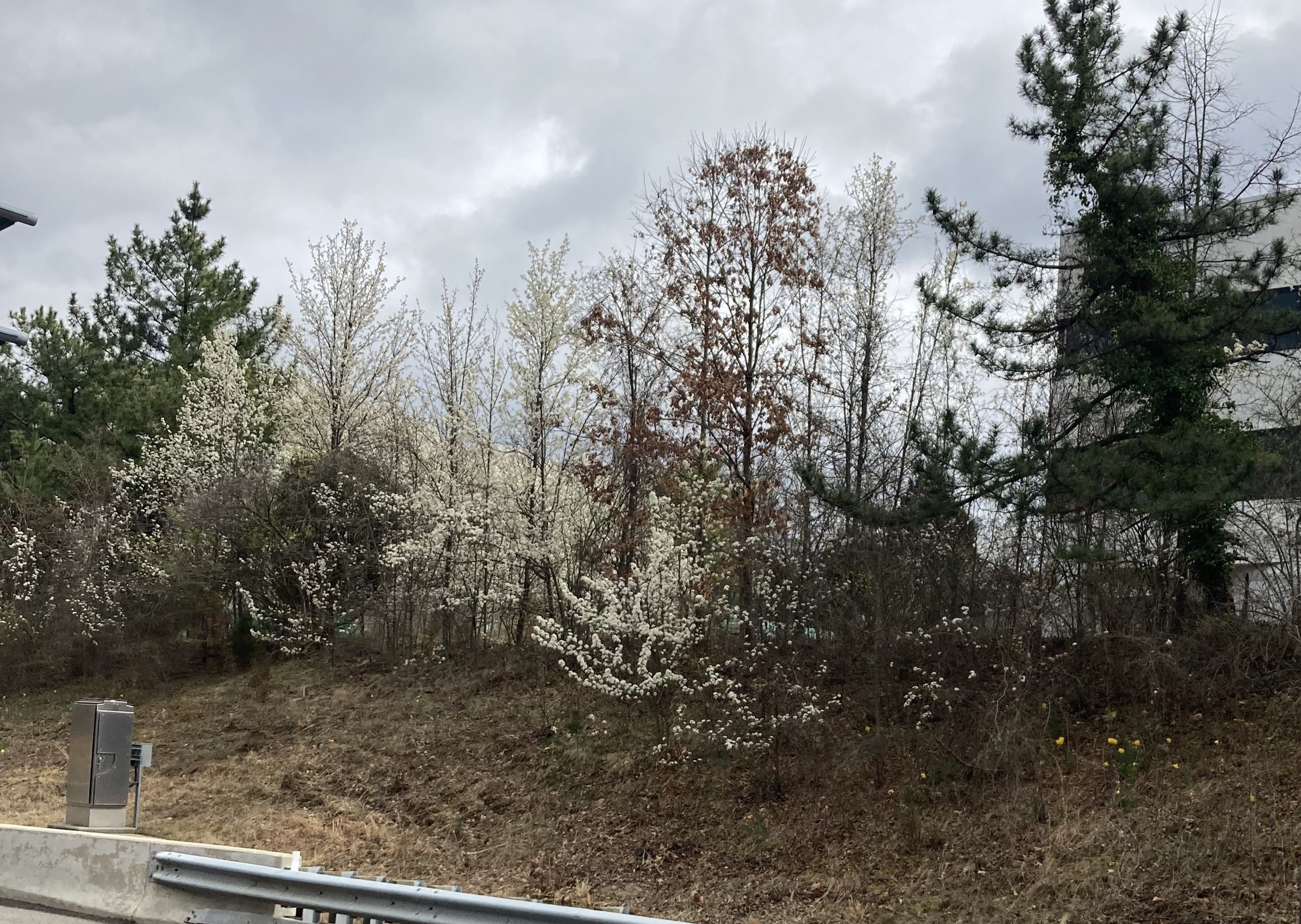
A homeowner once purchased a Callery or Bradford pear tree from a nursery, attracted by its pretty spring flowers. A few years after planting, she noticed thorny saplings popping up along her fence line… then in the field next door… then in the woods beyond that. What started as one tree had become a spreading invasion. This story is happening all over the Mid‑Atlantic Region.
What is it? Why don’t we like it?
- Bradford pear is a type of ornamental Callery pear from China.
- It became very popular for landscapers in the 1960s for its neat shape, early and showy white blooms, and bright fall colors.
- It was advertised as sterile, but once new cultivars were introduced, they began cross‑pollinating.
- Birds spread seeds that grew into weedy trees that quickly invaded farmlands and natural areas. Today, ornamental pears are considered invasive in 29 states.
- Once they escape into fields and forests, they grow fast, form dense thorny thickets, and push out native plants. Their thorns can be up to 3 inches long—sharp enough to puncture tractor tires.
- Callery pear trees are known for having weak branches that easily break off and can damage cars or hurt people...a serious hazard!
- Their leaves smell like rotting fish! And their flowers? Many people say they smell like unwashed gym socks….making these trees not so attractive after all!
Where does it spread?
Bradford pears show up along roadsides, in pastures, forests, wetlands, meadows, and vacant lots. They often go unnoticed until they’re old enough to bloom and then spread.
How can you identify it?
- Shiny, thick, dark green leaves with tiny rounded teeth
- Early‑spring white flowers with a strong, unpleasant odor
- Small round fruits (pea‑ to cherry‑sized)
- Thorns on many naturalized trees
- Brown, shallowly furrowed bark on older trunks
How can you remove it?
Removing Bradford pears takes persistence because their seeds can survive in the soil for at least 10 years.
- Don’t mow small trees — this causes even more resprouting.
- Cutting alone won’t work — untreated stumps send up new shoots.
- Foliar spray with herbicide can control trees under 6 feet tall.
- Cut‑stump or hack‑and‑spray methods work for larger trees.
- Continue monitoring the site for new seedlings.
What should you plant instead?
The best solution is simple: don’t plant Bradford pears or any of their look‑alike cultivars. Removing existing ones helps protect nearby natural areas and reduces the spread of new seeds.
There are many plants native to Fairfax that can replace Callery Pear as a landscape tree and grow under similar conditions. You can find them on the Plant NOVA Natives tree choice page.
Join the movement! Fairfax Tree Rescuers PRISM is a community-wide effort to save our trees from invasive plants. https://www.fairfaxprism.org/